
Pathology AI needs slide‑level traceability and patch‑level QC — or it won’t be trusted.
Whole-slide imaging breaks silently with stain shifts, scanner differences, patch sampling bias, and subjective ground truth. Trinzz treats pathology datasets as governed systems: WSI provenance, tile sampling governance, patch QC, quantified consensus, and evidence packs shipped with every versioned release.
Imaging annotation — engineered for deployment
Trinzz turns imaging annotation into a governed reliability system: AI assists, experts validate, agreement is quantified, QC is systematic, and releases ship with evidence.
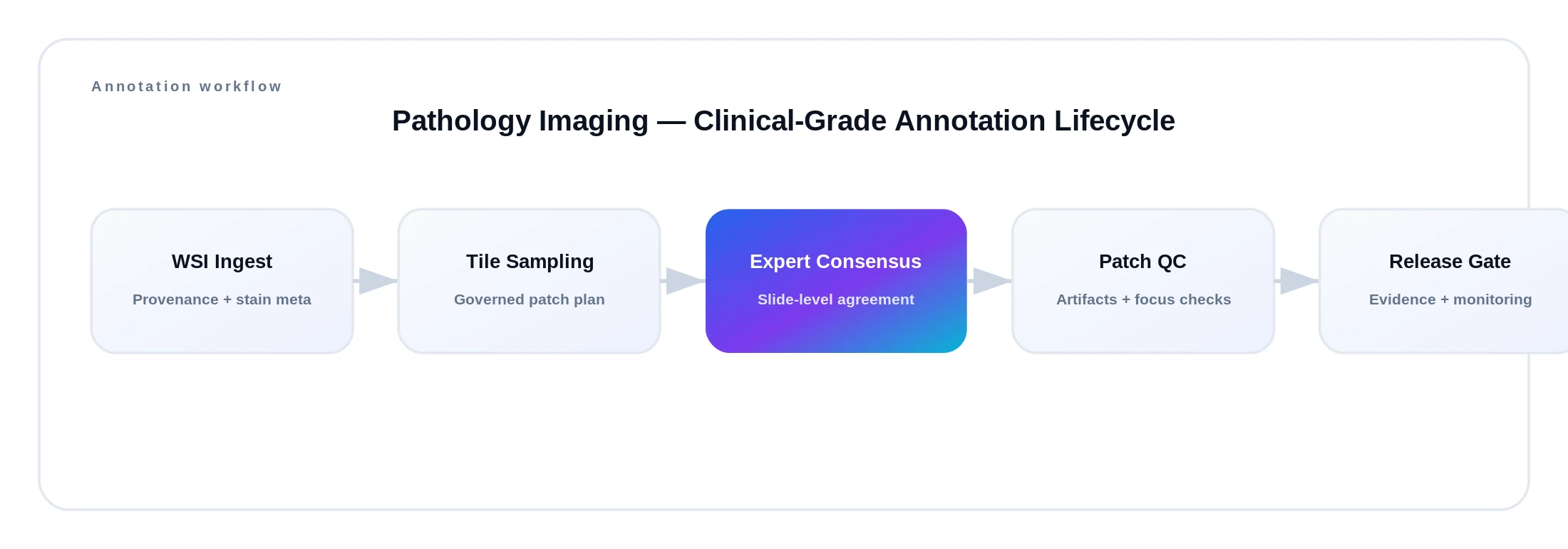
Whole‑slide datasets that reviewers can defend
This is what turns a dataset into something procurement + clinical validation can sign off on.
Sampling, stain shift, and patch QC — made explicit
Pathology datasets break when sampling and staining are implicit. We turn them into governed artifacts.
Sampling plan as evidence
How tiles are chosen, excluded, stratified, and re-sampled—so training is reproducible and defensible.
- Inclusion/exclusion criteria
- Hard‑negative strategy
- Slide/region stratification
Patch QC that catches silent failure
Automated checks for focus, artifacts, and stain intensity shifts—before they become model regressions.
- Focus score thresholds
- Artifact detection flags
- Stain shift indicators + triggers
Where this should convert
Written for enterprise imaging teams evaluating deployment readiness.
What you get with every release
Evidence reduces “trust debates” to artifacts.
- WSI slide + tile manifests + version hash
- Patch QC report: focus/artifact rates, stain shift indicators, bias checks
- Consensus report: agreement metrics + adjudication summaries
- Sampling governance memo: inclusion/exclusion criteria + SOP mapping
- Monitoring spec: drift alerts + escalation workflow back into validation
- Lineage export: provenance, reviewer identity, timestamps, SOP references