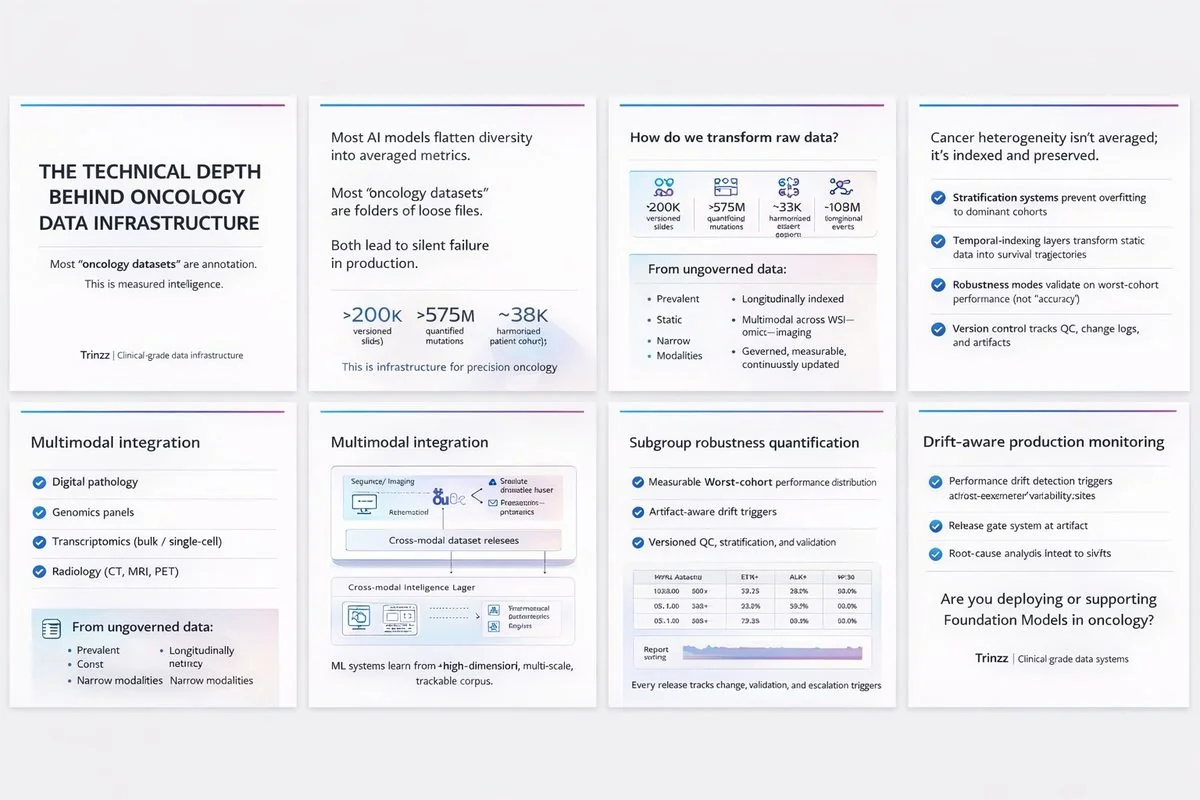
Cancer is heterogeneous across patients, within tumors, across time, and across modalities. Most AI systems collapse this complexity into averaged performance metrics.
We convert fragmented oncology signals into:
Trinzz builds structured oncology intelligence layers designed for foundation models, translational AI, and regulatory-grade deployment.
The Oncology Heterogeneity Failure
Most oncology AI fails in deployment because: .
Rare mutation cohorts are underrepresented

Tumor microenvironment signals are ignored
Longitudinal progression is flattened
Performance metrics are averaged across subtypes

Worst-cohort performance is unmeasured
Governance Checklist
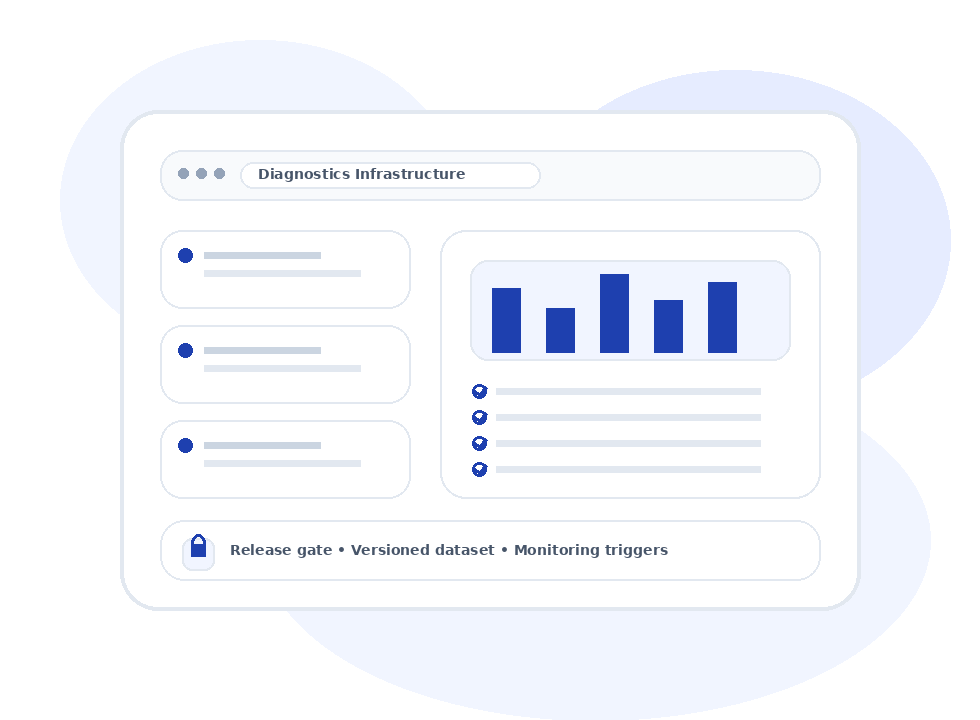
Change control, QC, consensus, lineage, drift triggers.
Reliability is measurable
We turn trust into numbers—so decisions become objective.
| Signal | Definition | How it prevents failure |
|---|---|---|
| Consensus | Silent performance collapse in minority cohorts | Overfitting to dominant molecular subtypes |
| QC | Subgroup stratification frameworks | Worst-cohort performance quantification |
| Drift | Longitudinal treatment-line indexing | Progression-aware dataset modeling |
| Release gate | Measurable reliability tracking across releases |
Multimodal Oncology Intelligence Layer
Our infrastructure integrates:
| Signal | Definition | How it prevents failure |
|---|---|---|
| Consensus | Whole Slide Imaging (WSI) pathology | Radiology (CT, MRI, PET) |
| QC | Genomic mutation panels | Bulk and single-cell transcriptomics |
| Drift | Proteomic pathway signatures | Longitudinal treatment outcomes |
| Release gate | ML-ready feature stores | Cross-modal embedding spaces |
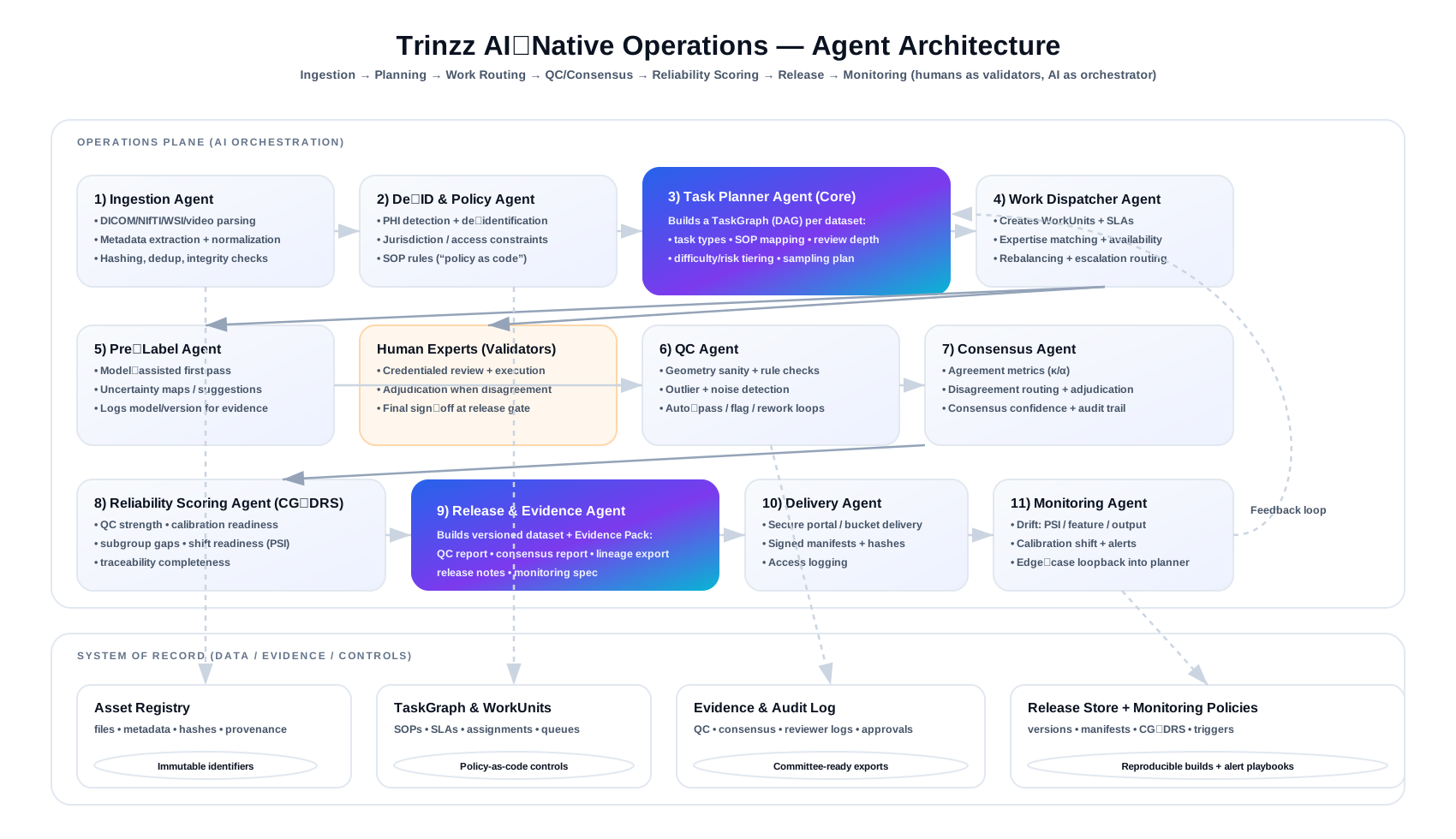
Agentic Governance Architecture
Oncology data evolves continuously. Our agentic system deploys specialized agents to ensure integrity, validation, and release safety across the data lifecycle.
Longitudinal Intelligence Layer
Cancer progression is temporal. We structurally preserve time as a governed data dimension rather than collapsing it.
We structurally preserve
This enables