
Radiology AI that survives deployment needs dataset reliability — not just accuracy.
Edge cases, scanner variation, protocol drift, and ambiguous ground truth are what break radiology AI in production. Trinzz ships radiology datasets as governed releases with quantified consensus, traceability, release gates, and monitoring triggers — so your model remains defensible and stable after deployment.
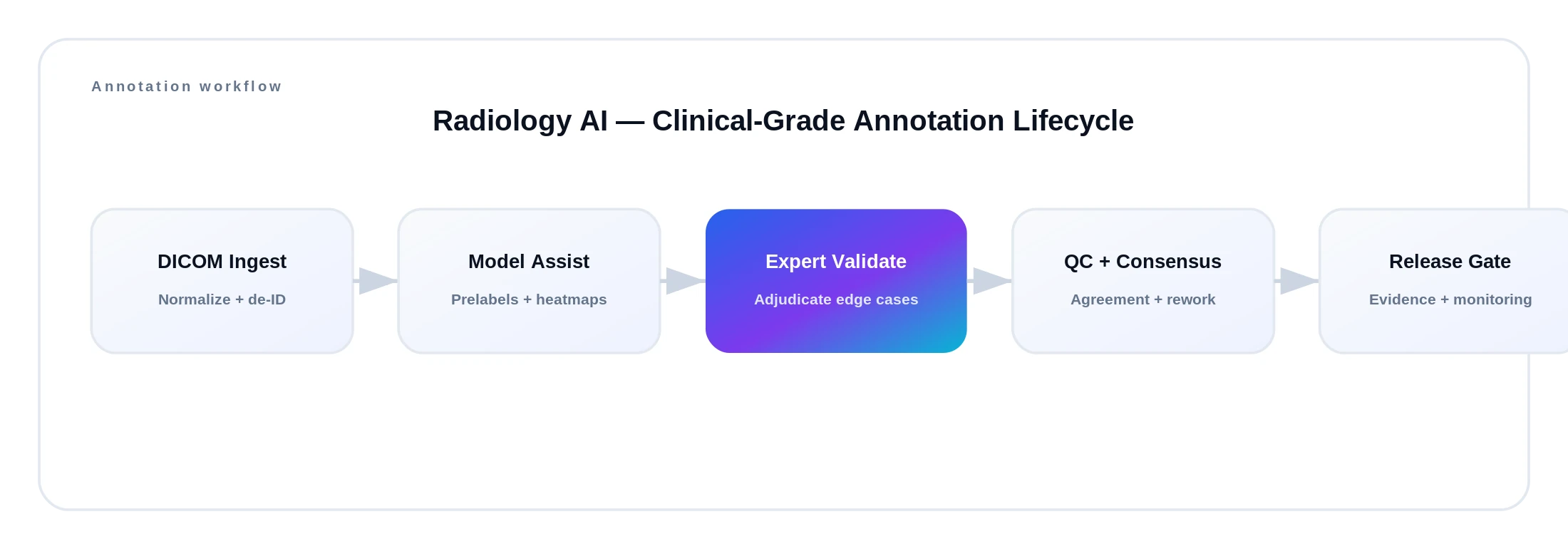
Imaging annotation — engineered for deployment
Trinzz turns imaging annotation into a governed reliability system: AI assists, experts validate, agreement is quantified, QC is systematic, and releases ship with evidence.
What radiology teams actually need to deploy
This is what turns a dataset into something procurement + clinical validation can sign off on.
Modalities + label types (built for clinical deployment)
Radiology programs fail when modality/protocol complexity is treated like generic labeling.
Where this should convert
Written for enterprise imaging teams evaluating deployment readiness.
What you get with every release
Evidence reduces “trust debates” to artifacts.
- Versioned manifest + hashes + deterministic release notes
- QC report: sampling plan, pass rates, structured error taxonomy
- Consensus report: κ/α, adjudication summary, confidence per cohort
- Subgroup risk register: site/scanner/protocol bins + worst-group gaps
- Monitoring spec: PSI thresholds, alert routing, remediation playbook
- Lineage export: who labeled what, when, under which SOP; approvals